
Your Notes Are Killing Trees (Here’s How to Stop It)
Eco conscious note digitizers are reusable smart notebooks that let you write by hand, then instantly save your notes digitally — so you never need to buy another paper notebook again.
Top eco-friendly smart notebooks at a glance:
| Product | Type | Best For | Key Feature |
|---|---|---|---|
| Rocketbook Fusion | App-scanning reusable | Professionals | 7 different page templates |
| Rocketbook Flip | App-scanning reusable | Students & general use | 1 notebook = 100+ paper notebooks |
| Stone Paper Notebooks | Erasable stone paper | Eco-focused users | 100% tree-free stone paper |
| Smart Pads | Real-time digitizer | Office professionals | Offline storage & Bluetooth sync |
Every year, the average person in Europe uses around 160 kilograms of paper — consuming 3 trees, 4,200 liters of water, and 260 liters of oil in the process. A big chunk of that paper waste comes from something most of us do every single day: taking notes.
Paper notebooks fill up fast. Then they pile up. Then they get lost — along with every idea inside them.
There’s a better way. Eco conscious note digitizers give you the feel of real handwriting with none of the waste. You write, you scan (or it syncs automatically), and your notes live in the cloud — searchable, organized, and always with you.
This guide covers the best options on the market right now, who each one is best for, and what to look for before you buy.

Understanding the Eco Conscious Note Digitizer and How It Works
At its core, an eco conscious note digitizer is a bridge between the analog world we love and the digital world we need. We all know that writing by hand is better for memory retention and focus—typing just doesn’t spark the same neural pathways. However, paper is static. You can’t “search” a physical notebook for a keyword from a meeting three months ago.
A note digitizer solves this by using specialized surfaces and smart technology to capture your strokes. Some models use synthetic, polyester-based pages that feel like paper but can be wiped clean with a damp cloth. Others use stone paper, which is 100% tree-free and naturally water-resistant.
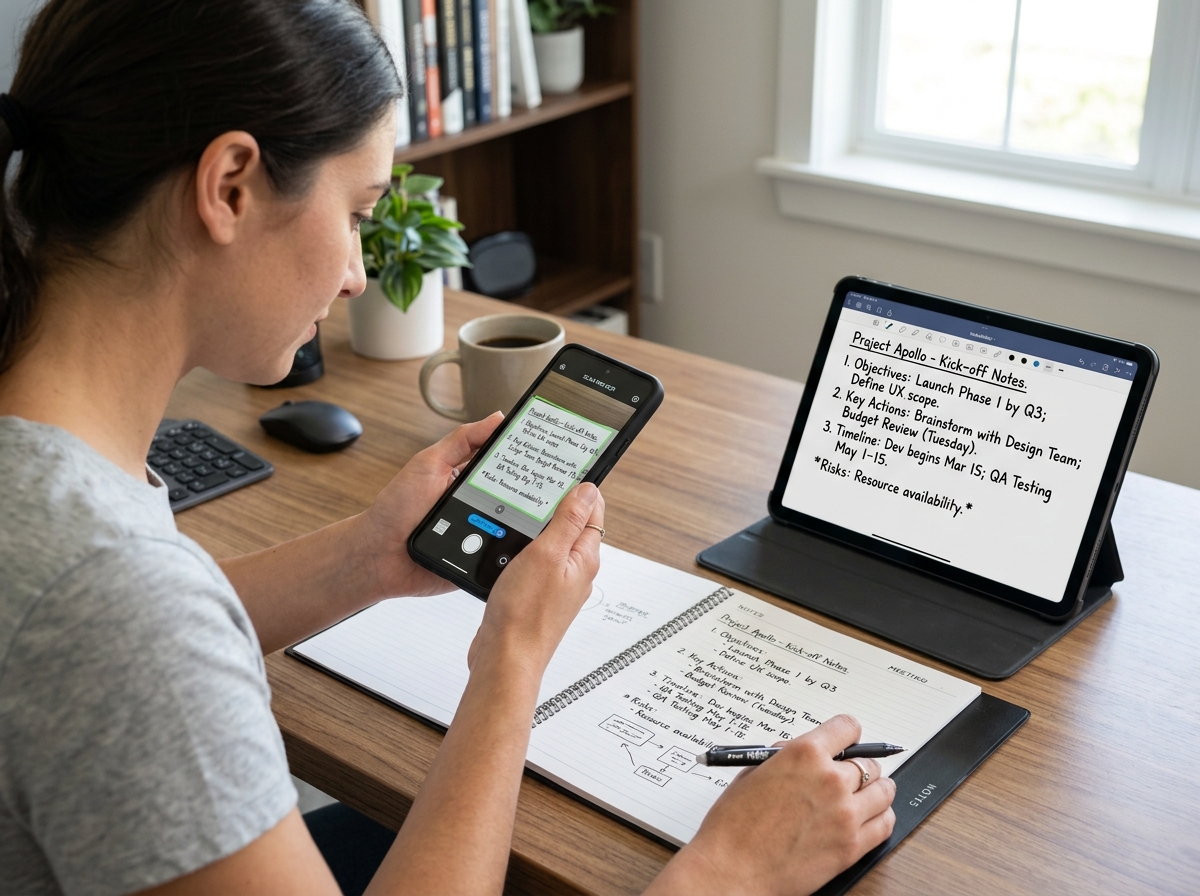
The magic happens during the “digitization” phase. Depending on the model, this occurs in one of two ways:
- App-Scanning: You write on the reusable pages, then use a specialized smartphone app to “scan” the page. The app recognizes the borders of the notebook and instantly crops, enhances, and uploads the image to your preferred cloud service.
- Real-Time Digitization: Devices like advanced smart pads or digital pens track your handwriting as it happens. These often feature offline storage—storing up to 50 or even 1,000 pages of “scribbles” in internal memory—before syncing to your devices via Bluetooth or USB.
For a deeper dive into these technologies, check out the ultimate guide to eco friendly smart notebooks.
How Handwriting-to-Digital Technology Works
You might wonder how a piece of plastic or stone paper understands your “chicken scratch.” The technology generally relies on three pillars:
- OCR (Optical Character Recognition): This is the heavy lifter. AI algorithms analyze the shapes of your letters and convert them into editable, searchable text. Modern OCR can even handle cursive and offer grammar or spell-check features.
- Vector-Based Capture: Instead of just taking a “photo,” many smart pens capture your writing as vectors. This means the digital version of your note isn’t a grainy image; it’s a mathematical map of your pen strokes that can be scaled infinitely without losing quality.
- Infrared and Pressure Sensors: Real-time digitizers often use a tiny infrared camera near the pen tip to track its position relative to a nearly invisible grid on the page.
The Environmental Impact of an Eco Conscious Note Digitizer
Why go through the trouble of switching? The statistics are staggering. In regions like Europe, the average person’s paper consumption requires 640 kilowatts of energy and 260 liters of oil annually. Furthermore, paper products contribute a surprising 8% to the total water footprint of society.
By switching to an eco conscious note digitizer, you are opting out of this cycle of consumption. For example, a single Rocketbook Flip can replace over 100 traditional notebooks. When you consider that one tree is typically required for every few dozen notebooks, the forest-saving potential of a single reusable device is immense.
Materials also play a huge role in the “eco” part of these digitizers. We are seeing a shift toward:
- Stone Paper: Made from calcium carbonate (waste from quarries) and a small amount of HDPE resin. It uses zero trees and zero water during production.
- RCS PU (Recycled Claim Standard Polyurethane): Used for covers, this material ensures that the protective casing of your notebook comes from recycled sources.
- FSC-Certified Packaging: Even the boxes these devices come in are often sourced from responsibly managed forests.
Reducing Your Carbon Footprint with an Eco Conscious Note Digitizer
The personal impact is just as clear. An average user of a reusable notebook saves approximately 300 to 520 A4 sheets of paper every single year. Over a decade, that is thousands of pages that didn’t need to be manufactured, transported, or thrown into a landfill.
This is the essence of the circular economy: buying one high-quality tool that lasts for years rather than dozens of disposable ones. To learn more about the best options for the planet, see our article on exploring the best reusable notebooks for sustainability.
Key Features, AI Capabilities, and Choosing the Right Model
When choosing your eco conscious note digitizer, you need to decide between simplicity and high-tech integration.
| Feature | App-Scanning (e.g., Rocketbook) | Real-Time Digitizers |
|---|---|---|
| Battery Needed? | No | Yes |
| Erasability | Water-wipeable pages | Usually requires page refills |
| Storage | Unlimited (via Cloud) | Limited internal (e.g., 50 pages) |
| Best For | Students, Journaling | Executive Meetings, Sketching |
Beyond the hardware, the software is where these devices truly shine. Many now feature AI-powered tools that can summarize a long meeting into a few bullet points, translate your notes into different languages, or even turn a rough sketch into a polished digital illustration.
If you are looking for the absolute top-tier options, browse our list of the best eco friendly smart notebooks.
Advanced AI and Cloud Integration in an Eco Conscious Note Digitizer
The modern eco conscious note digitizer isn’t just a place to write; it’s a productivity hub. Most of these devices integrate seamlessly with the apps you already use:
- Cloud Sync: Automatically send scans to Google Drive, Evernote, Dropbox, or Slack.
- Smart Titles: By writing a title between double hashtags (e.g., ##Meeting Notes##), the app can automatically name your digital file.
- Task Management: Some apps can recognize a “To-Do” list and automatically sync those items with Apple Reminders, Google Tasks, or Microsoft To-Do.
To get the most out of your setup, you might want to look into innovative accessories for reusable notebooks, such as specialized pen holders or cleaning kits.
Selecting the Best Digitizer for Students and Professionals
Different users have different needs.
- For Students: Look for notebooks with diverse page layouts (dotted, lined, and blank) and high durability. The ability to scan and organize notes by subject into Google Drive is a lifesaver during finals. Check out our guide on reusable notebooks for students for specific recommendations.
- For Professionals: Style matters. Look for models with vegan leather covers or RCS PU finishes. Features like “Minutes of Meeting” (MOM) templates and real-time syncing during a presentation can make you the most efficient person in the boardroom.
- For Creatives: Real-time digitizers are often better for sketching, as they capture the pressure and nuance of your pen strokes more accurately than a standard scan.
Maintenance, Care, and Overcoming Technical Limitations
To ensure your eco conscious note digitizer lasts for years, you have to treat it right.
The Golden Rules of Maintenance:
- Use the Right Pen: Most reusable notebooks require Pilot FriXion pens. These use thermo-sensitive ink that disappears with heat or friction (or a wet cloth). Using a standard ballpoint pen will permanently ruin the pages.
- Clean Regularly: Don’t leave ink on the pages for months at a time, as this can lead to “ghosting” (faint stains). We recommend wiping your pages clean at least once a month.
- Gentle Touch: You don’t need to press hard. The synthetic surfaces are designed for fluid writing. Heavy pressure can leave indentations in the page coating.
While these devices are revolutionary, they aren’t perfect. OCR accuracy can vary based on how neat your handwriting is. If you’re a doctor with “creative” penmanship, you might find yourself doing a bit of manual editing. Additionally, some models require a battery or charging, which is one more thing to remember before a long day of classes or meetings.
To protect your investment, consider cases made for eco-friendly smart notebooks to prevent scratches and keep your specialized pens safe.
Frequently Asked Questions about Note Digitizers
How many times can you reuse an eco-conscious note digitizer?
Most high-quality reusable notebooks are designed to be wiped clean and reused hundreds of times. If you follow the maintenance tips above, a single notebook can easily last 2-3 years of daily use.
Do these devices require a battery or constant charging?
It depends on the type. App-scanning notebooks (like Rocketbook) require no batteries at all—the “smart” part is in your phone’s app. Real-time digitizers and digital pens do require charging, though many use E-ink technology or low-power Bluetooth to ensure the battery lasts for days or even weeks.
Can the AI recognize messy handwriting or cursive?
Yes, but with caveats. Most modern AI-powered OCR is surprisingly good at deciphering cursive. However, if your handwriting is extremely illegible, the accuracy will drop. Most apps allow you to quickly edit the digitized text to fix any errors.
Conclusion
The shift toward a more sustainable lifestyle doesn’t mean giving up the tools that make us productive. By adopting an eco conscious note digitizer, you get the best of both worlds: the cognitive benefits of handwriting and the organizational power of the digital cloud.
Whether you are a student trying to organize seven subjects or a professional looking to declutter your desk, there is a sustainable option waiting for you. Transitioning to a paperless workflow is a small change for you, but a massive win for the planet.
Ready to make the switch? Start by exploring affordable alternatives to traditional notebooks and join the movement toward sustainable productivity.
For more information and to browse our curated selection of smart notebooks, visit us at Open Diode.
